I’m excited to share that the third book in the Wings over Albion series, Dragon’s Folly, will be coming out on October 9th. It’s currently available for pre-order.
Writing Dragon’s Folly was a blast, especially with the contrast of an endlessly upbeat, relentlessly talkative optimist clashing with a stern, self-contained dragon who’s used to controlling everyone and everything around him. Forced proximity is one of my favourite tropes, as it means neither can run away from the other, and they have to find a way to get along. Or not…
Falling for him would be pure folly. I know that. Now all I have to do is convince my heart…
Allowing a strange dragon into my home was not my idea.
The Assembly assured me it was necessary, though. And that’s how I ended up with him.
Ollie Shaw is clumsy. Unfairly hot. He stumbles through my life leaving a trail of chaos and sunny charm in his wake.
And I hoard every moment with him like he’s my greatest treasure.
But with an entire dragon territory to rule, bills to pay, and treachery brewing in my family, I can’t afford to be distracted by Ollie’s copper-gilded beauty and boundless enthusiasm.
I especially can’t give in to my dragon’s primal urge to claim him.
Because loving him could cost me everything I’ve fought so hard to protect. And that would eventually come back to bite us both—with dragon’s teeth…
The book can be read as a standalone, but contains cameo appearance from some old friends.
Today is release day for In the Dragon’s Lair, and I’m so pleased to be able finally to share Nate and Alex’s adventures with you. Obligatory disclaimer: their views on Jane Austen are not necessarily mine!
A brief guide to some of the places in Bath featured in the book can be found on my blog post here.
Nate Mortimer is hot, funny, and kissing him is like falling into the sun.
He’s also the last man I should ever be with.
He’s smooth, wealthy, and practically dragon royalty. Me? I’m just a dragon from the Cornish countryside. Or so I like people to think.
I’m investigating the Fortescues, one of the richest, most powerful dragon families in Britain. Problem is, I’m not the only one who’s undercover. Every time I turn around, Nate’s in my way.
Can I trust him? He has his own issues with the Fortescues. Those dragons are dangerous, and his plotting could draw me into a lethal power struggle. His emotional baggage and troublesome ex? Also problematic.
And none of that helps me keep my mind—or hands—off him.
If I’m not careful, falling for the wrong dragon-shifter could cost me so much more than just my heart…
In the Dragon’s Lair is an m/m paranormal romance. Book 2 in the Wings over Albion series, it can be read as a standalone.
In the Dragon’s Lair introduces Alex Teague, a dragon-shifter whose family comes from Cornwall. When writing this story, I took a few liberties with English folklore—tales of dragons are less common in Cornwall compared to the rest of the country.
One intriguing explanation for the relative scarcity of dragons in Cornish folklore is that the region suffered fewer attacks by Vikings. It’s suggested that, without the dragon prows of Viking ships, dragons didn’t occupy the forefront of people’s minds. I’m not entirely convinced by this explanation. I live in a landlocked part of England, yet there is still a strong local tradition of dragons—or rather, one dragon: the one killed by St George at Dragon Hill, near Uffington Castle.
Dragon Hill, seen from White Horse Hill.
Dragon Hill is a natural chalk mound with a top that was flattened artificially sometime before the Roman invasion of Britain. The patch of chalk on which no grass grows is said to be where the dragon’s blood spilled. Dragon Hill is also mentioned in Arthurian legends as the place where Arthur’s father, Uther Pendragon, was killed in battle and laid to rest. As if that wasn’t enough, the hill is thought to have been the inspiration for Weathertop in The Lord of the Rings.
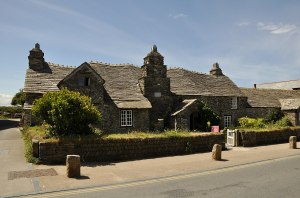
The Old Post Office, Tintagel
Despite the relative dearth of dragons in Cornwall, when I visited Tintagel village, I was told that dragons were responsible for the wavy roof line of the fourteenth-century Old Post Office. Apparently, they used to perch there. Alex would like to assure you he would never be so thoughtless as to cause a roof to sink.
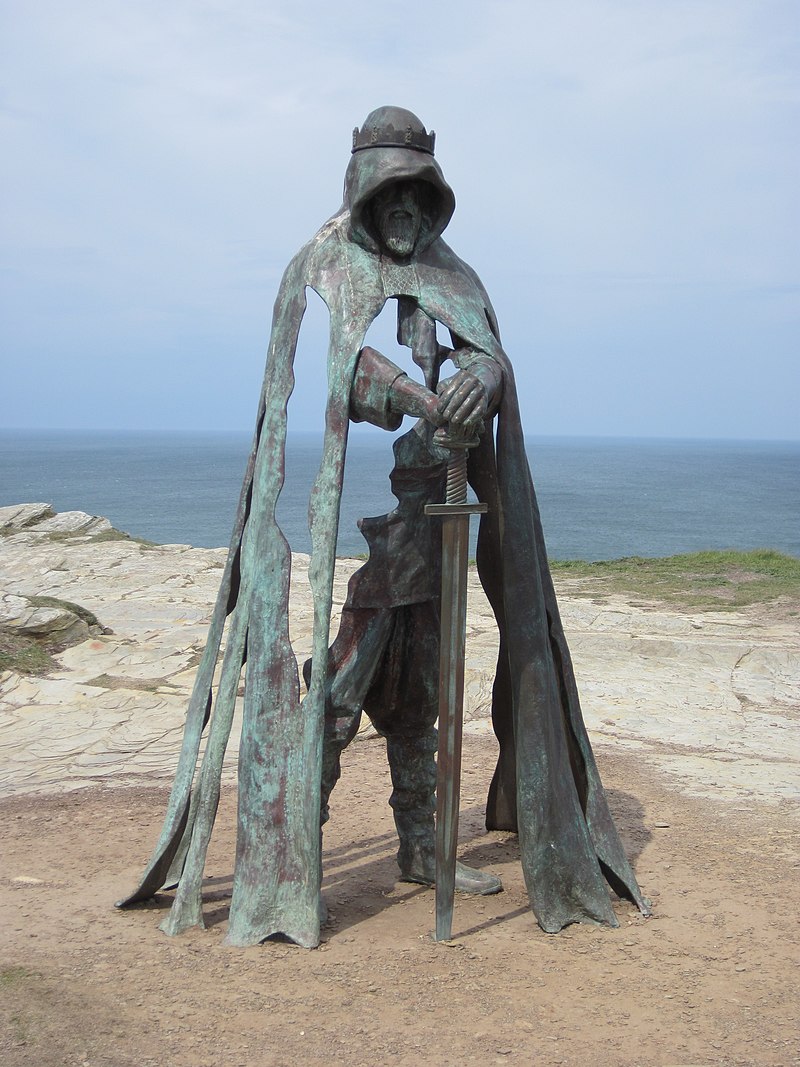
Tintagel has been intertwined with Arthurian myths and legends ever since Geoffrey of Monmouth suggested it was where King Arthur was conceived. It wouldn’t be right to mention the place without sharing a picture of the bronze sculpture that was erected at Tintagel Castle in 2016. English Heritage, who installed the sculpture, insist that it isn’t a representation of a single person, but it is commonly referred to as King Arthur. It’s striking, whoever it is!
Sculpture at Tintagel Castle
I’m looking forward to sharing Alex and Nate’s adventures with you on June 10th.
I’m thrilled to share that Nate and Alex’s story, Book Two in the Wings over Albion series, is coming out on June 10th. It’s available for pre-order now, and will also be available on Kindle Unlimited.
The book is set in the English city of Bath, and a photographic guide to some of the places mentioned can be found here, in an earlier blog post.
Nate Mortimer is hot, funny, and kissing him is like falling into the sun.
He’s also the last man I should ever be with.
He’s smooth, wealthy, and practically dragon royalty. Me? I’m just a dragon from the Cornish countryside. Or so I like people to think.
I’m investigating the Fortescues, one of the richest, most powerful dragon families in Britain. Problem is, I’m not the only one who’s undercover. Every time I turn around, Nate’s in my way.
Can I trust him? He has his own issues with the Fortescues. Those dragons are dangerous, and his plotting could draw me into a lethal power struggle. His emotional baggage and troublesome ex? Also problematic.
And none of that helps me keep my mind—or hands—off him.
If I’m not careful, falling for the wrong dragon-shifter could cost me so much more than just my heart…
In the Dragon’s Lair is an m/m paranormal romance and Book 2 in the Wings over Albion series.
Things have been quiet here of late because I’ve been working hard on the next book in my dragon-shifter series. In the Dragon’s Lair is about Nate, Rufus’s brother, and the mysterious dragon he meets in the English city of Bath.
It will be released early in June. In the meantime, I hope you’ll enjoy a quick guide to parts of Bath featured in the book (credits for photos are at the end of the post).
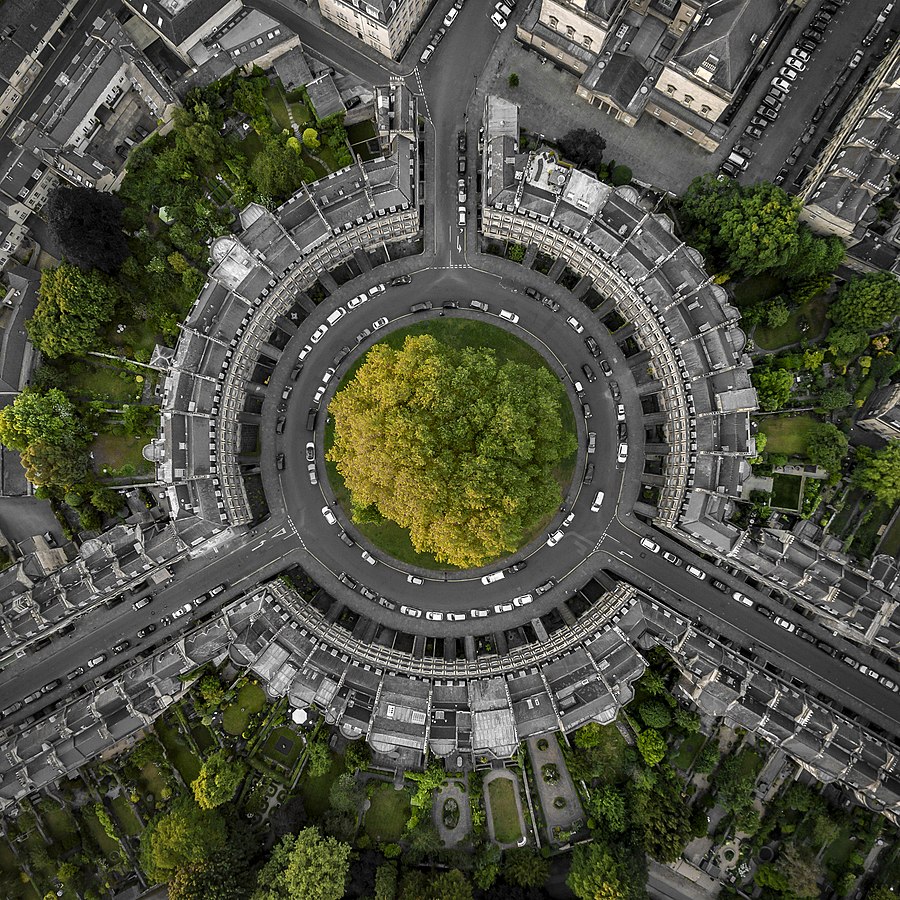
Above: Aerial view of The Circus; street view of The Circus.
The Circus is a ring of Georgian townhouses built in creamy Bath stone. It’s central to the book.
Georgian Bath was designed in large part by John Wood the Elder and his son, John Wood the Younger. The Elder was responsible for The Circus. Although I know the place well, I didn’t realise how much mystical symbolism is present in the architecture until I began researching In the Dragon’s Lair. Without giving too much away, that’s rather apt for the book.
The Elder believed there had been druidic temples on one of the hills just outside the city, and along with various Masonic symbols, there are acorn finials adorning the houses in The Circus.
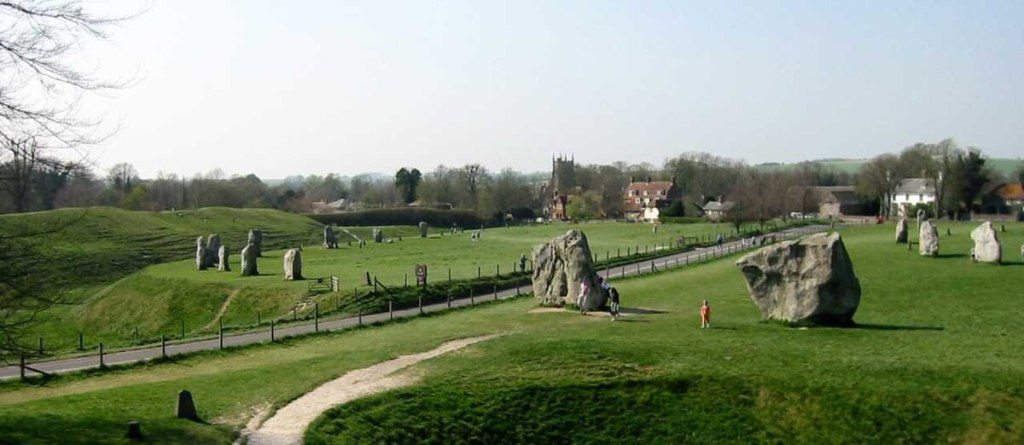
John Wood the Elder was fascinated by myths and legends as well as Freemasonry, and he’s said to have taken inspiration from Stonehenge when planning The Circus. The Circus is supposed to represent the sun, the Royal Crescent the moon, and Queen Square, where Nate and Alex have their first proper conversation, the Earth.
Apparently, the street connecting the Royal Crescent and The Circus follows the path of a ley line.
In the aerial view of the The Circus, you can see the Upper Assembly Rooms at about one o’clock. They’re a treat to visit if you’re into Georgian history. My characters, Nate and Alex, attend a function there. Sadly, neither is the type to describe the setting in any detail — never have I been so tempted to add a picture to a book!
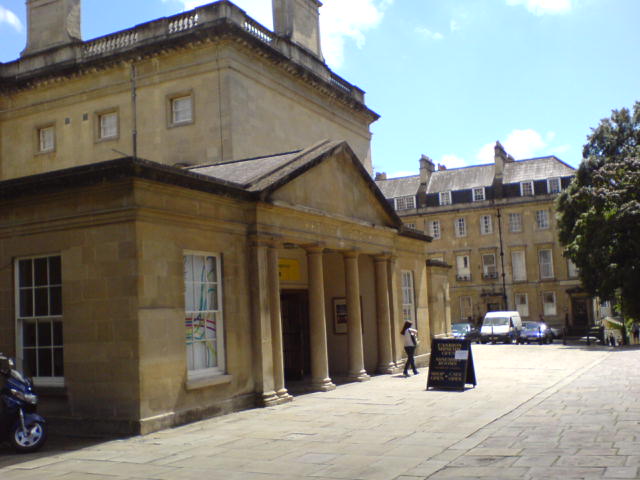
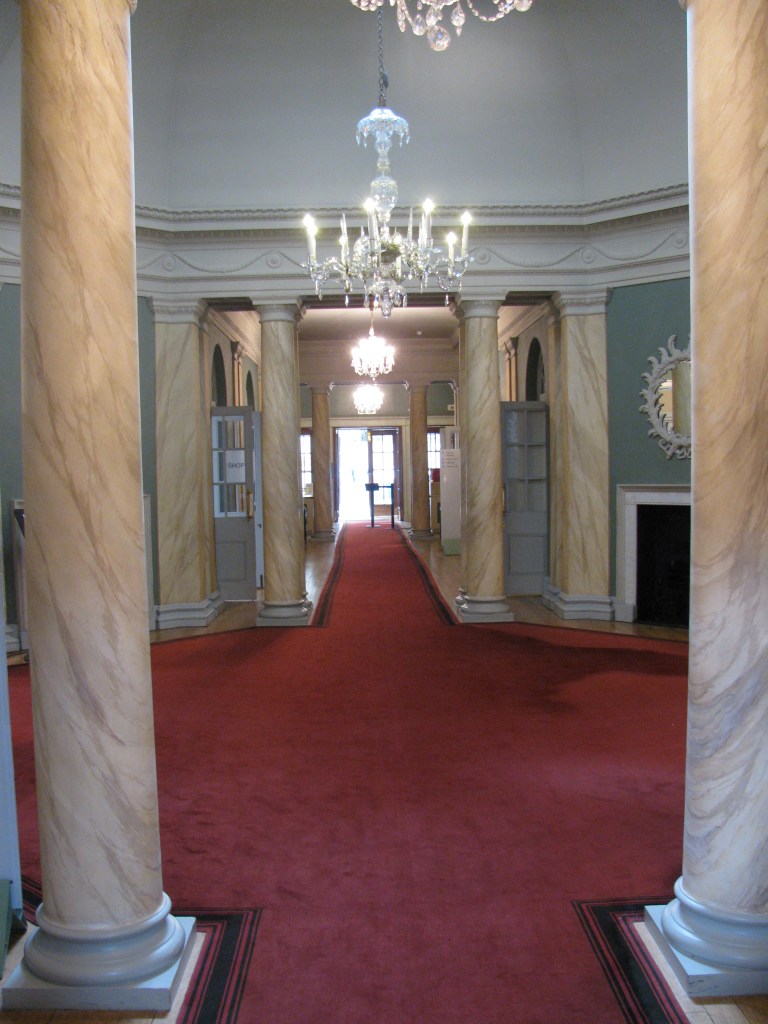
Above: exterior of the Upper Assembly Rooms.Interior, looking towards front door.
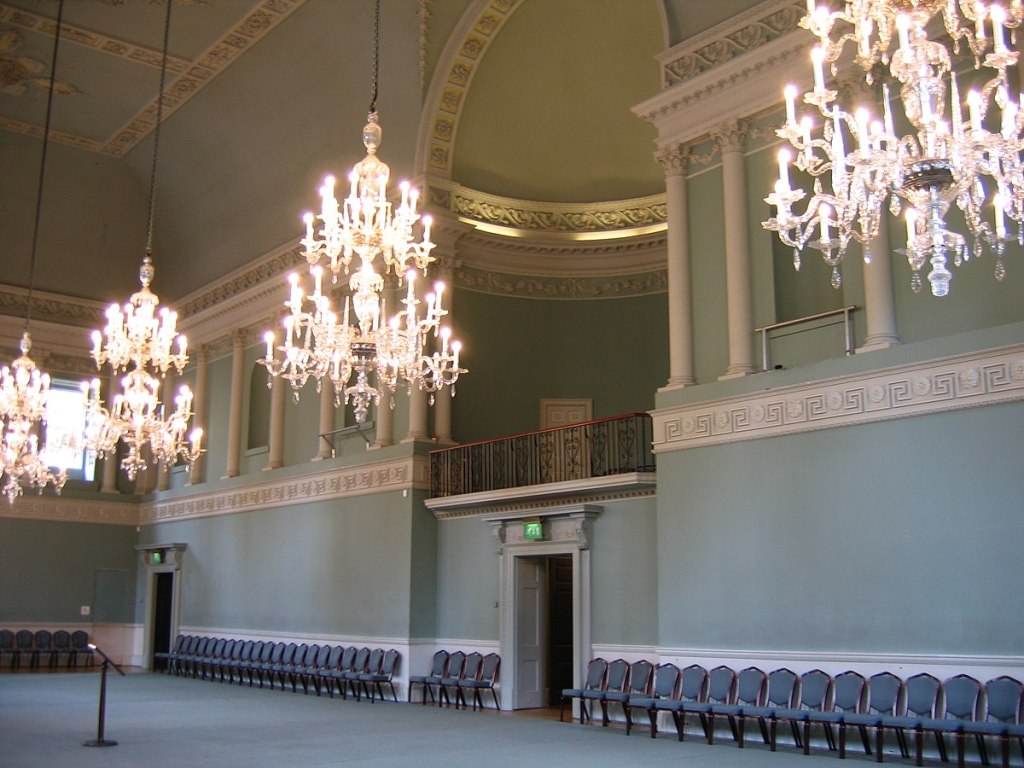
Above: the ballroom, with the balcony where the band played; the ballroom’s moulded ceiling.
The Tea Room
The Great Octagon
Just down from The Circus is Queen Square, so named because it was dedicated to Queen Caroline, George II’s wife. Palladian townhouses surround a garden, in which a tall obelisk is the focal point. The obelisk was erected in 1738 by Beau Nash in honour of the Prince of Wales. It used to rise from a circular pool of water, but sadly that pool is long gone, along with some of the obelisk’s height (it was damaged in a gale in 1815).
Most importantly, for my purposes, the garden has benches and privacy.
Above: Pulteney Bridge and weir; The Royal Crescent.
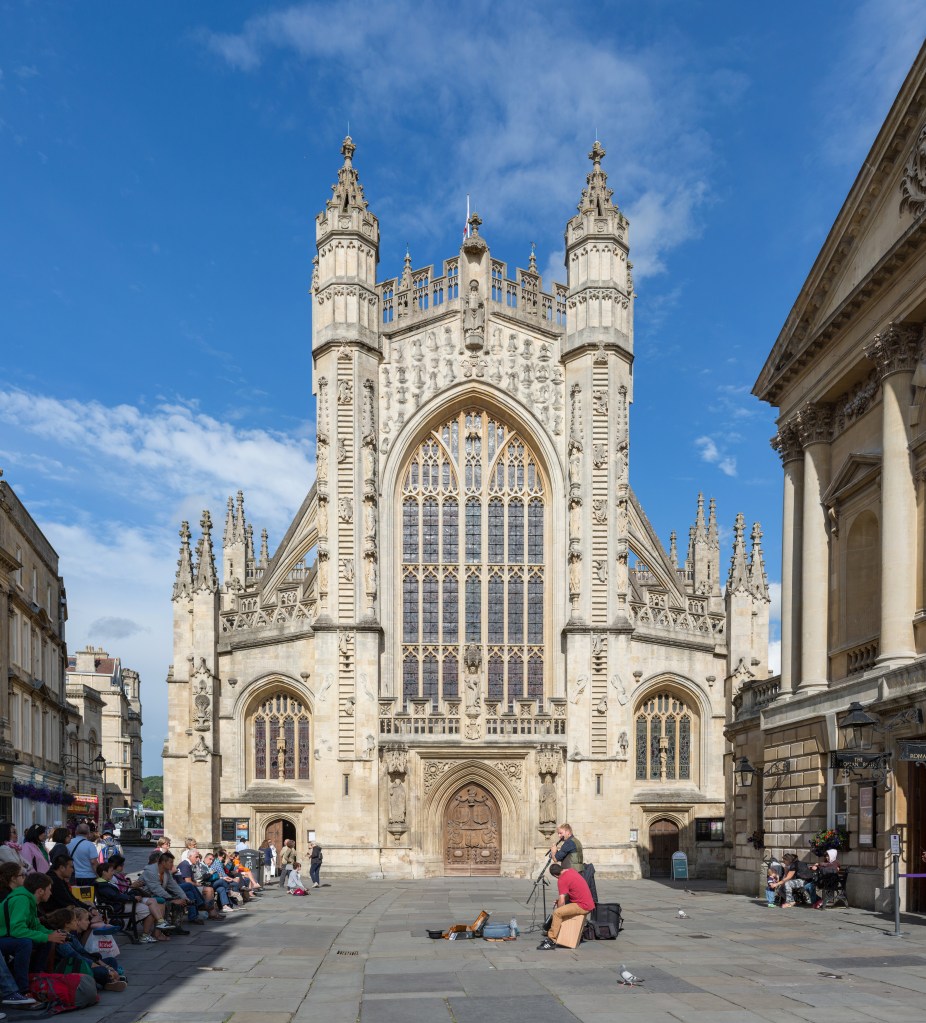
Something I discovered when writing this book — two of the angels on the carving of Jacob’s Ladder on the front of Bath Abbey are going down headfirst. Or perhaps they’re going up bottom-first. It sounds uncomfortable, whichever way it is.
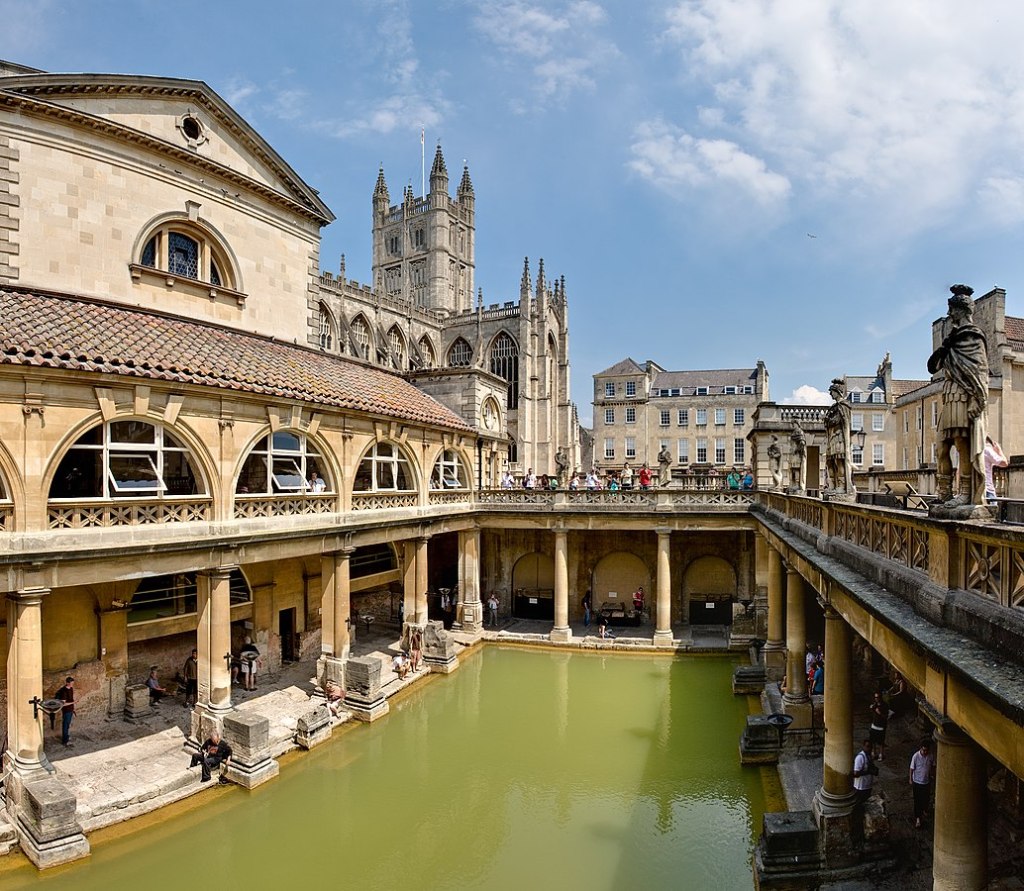
Roman Baths – Photo by David Iliff License: CCÂ BY-SA 3.0
Bath Abbey – Photo by David Iliff. License: CCÂ BY-SA 3.0.
I hope you’ve enjoyed this dragons’ eye view of another of my favourite cities. I can’t wait for you to meet Nate and Alex!
I’m delighted to be able finally to share Mark and Rufus’s adventures with you. Their story is now available both to buy and on KindleUnlimited here: https://bookgoodies.com/a/B0CQ39QGXF
Dragons aren’t real. Or so I used to think.
Oxford isn’t exactly what I’d imagined. Sure, the colleges are romantic, and everyone is brilliant enough to trigger my impostor syndrome. I expected that.
The dragon, however, was a big surprise.
I saw him on my first day. The beautiful beast spoke to me, then disappeared. I’ve been looking for him ever since. When I’m not on a wild dragon chase, I spend my time in the library. I’d like to think I’m only there to study, but who am I kidding?
I’m there for him.
Rufus Mortimer is the world’s hottest librarian. He’s strict, enigmatic, and sexy. He makes me feel things I’ve never felt before.
But he has a secret. One that could destroy everything.
So now, all I have to do is find a dragon, earn my doctorate, and try not to let my new romance burn my life to the ground. Easy, right?
I wish…
And if you’d like a quick, pictorial overview of some of the places in the book, you can find that here.
The Red Dragon of Oxford is released on 15th January, and I thought it would be fun to share pictures of some of the places featured in the book. Credits for photos are at the bottom of the post.
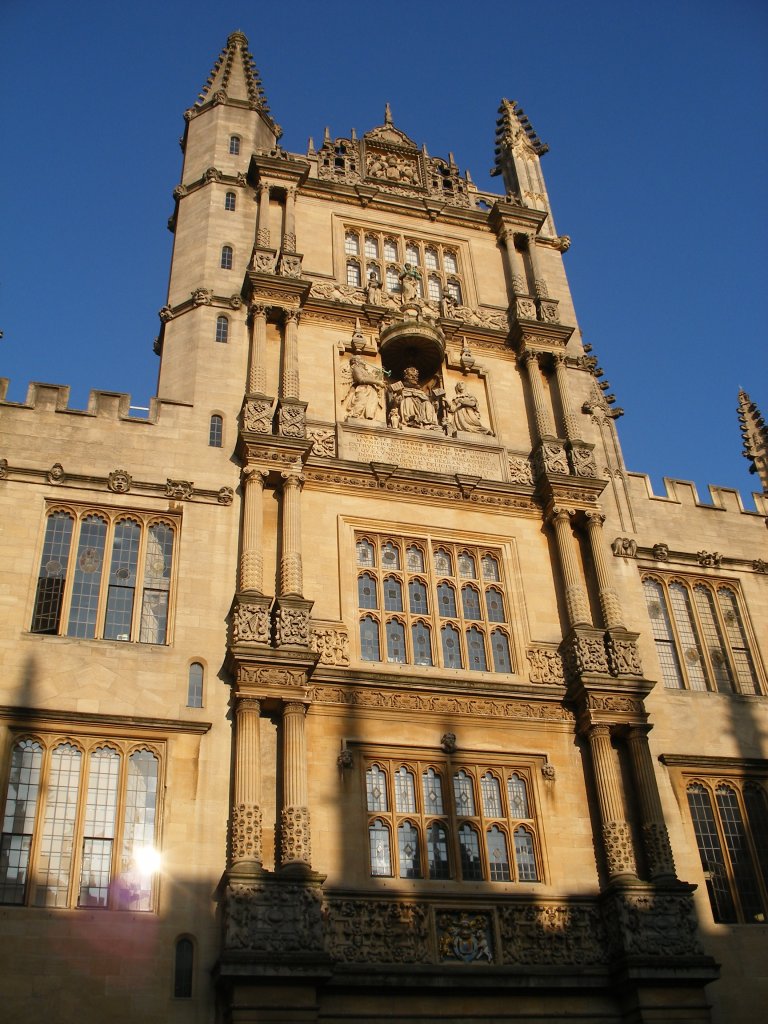
Much of the action takes place in the library of fictional Mortimer College. Given the importance of libraries in the book, it feels wrong not to include pictures of the university’s central research library, the Bodleian.
Bodleian exteriorOldest part of the Bodleian Library, dating from 15th century.
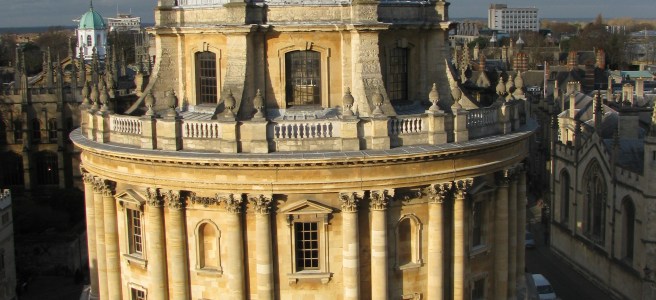
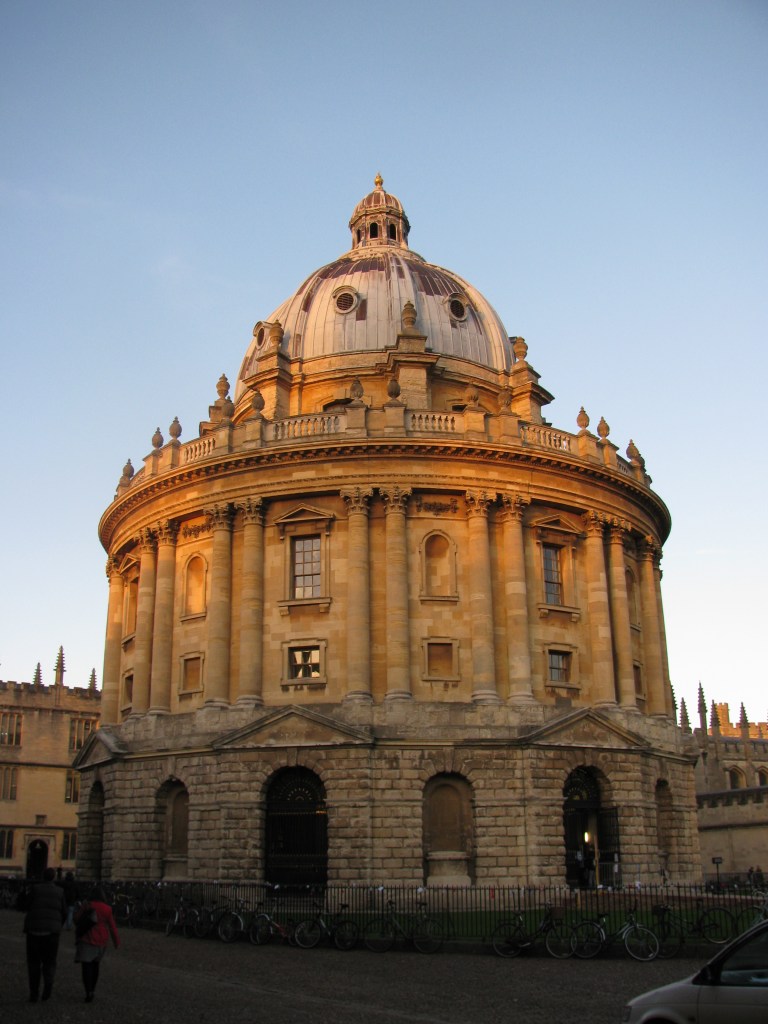
The iconic Radcliffe Camera, which forms part of the Bodleian. It was built between 1737 and 1749:
Radcliffe Camera from St Mary’s towerRadcliffe Camera from Radcliffe Square
And just because it’s beautiful – Queen’s College upper library:
The Queen’s College Upper Library
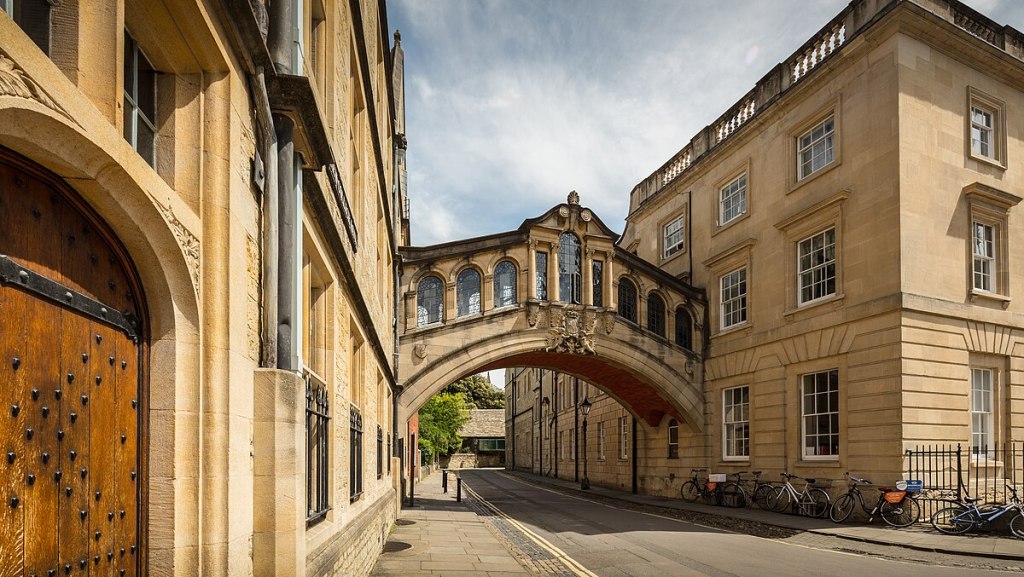
Just to the side of the Bodleian is the Sheldonian, with the mysterious heads on pillars outside that leave Mark so unimpressed. Rufus’s favourite bridge in Oxford is to the right of the Sheldonian.
The SheldonianHertford’s Bridge of Sighs
Mortimer College is, of course, fictional, but in the book it’s one of the 39 colleges that make up the University of Oxford. Please don’t ask me which one I booted out to make space for it!
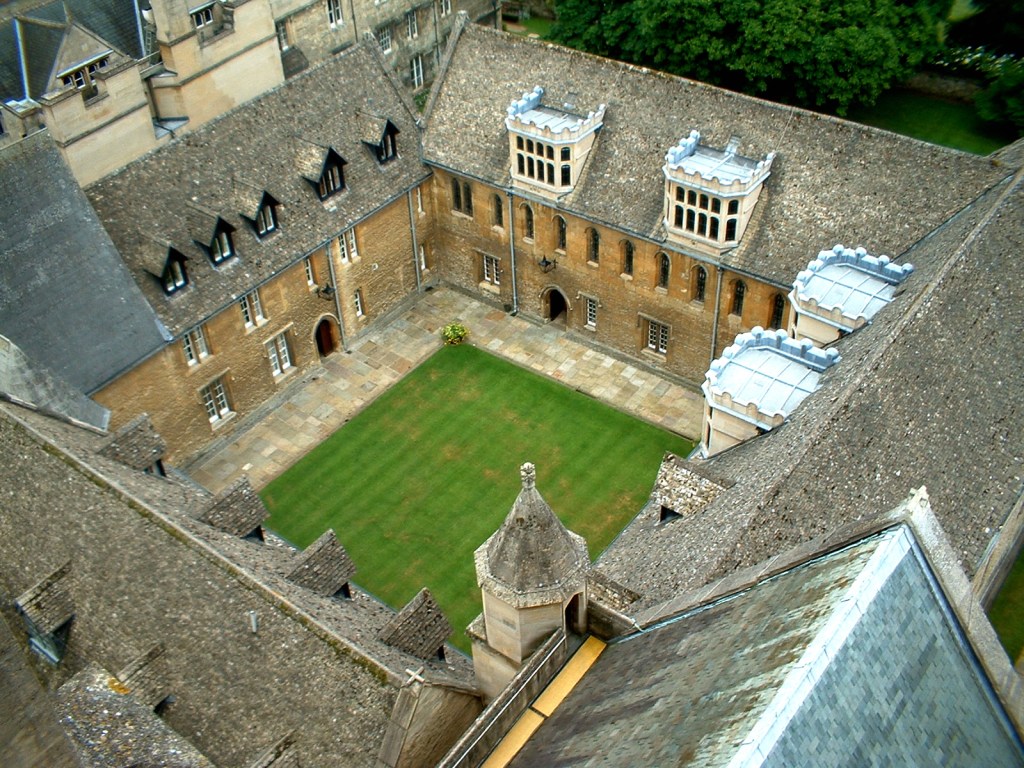
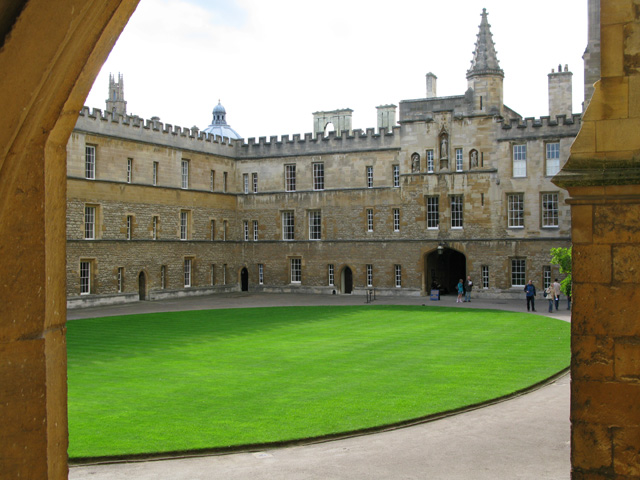
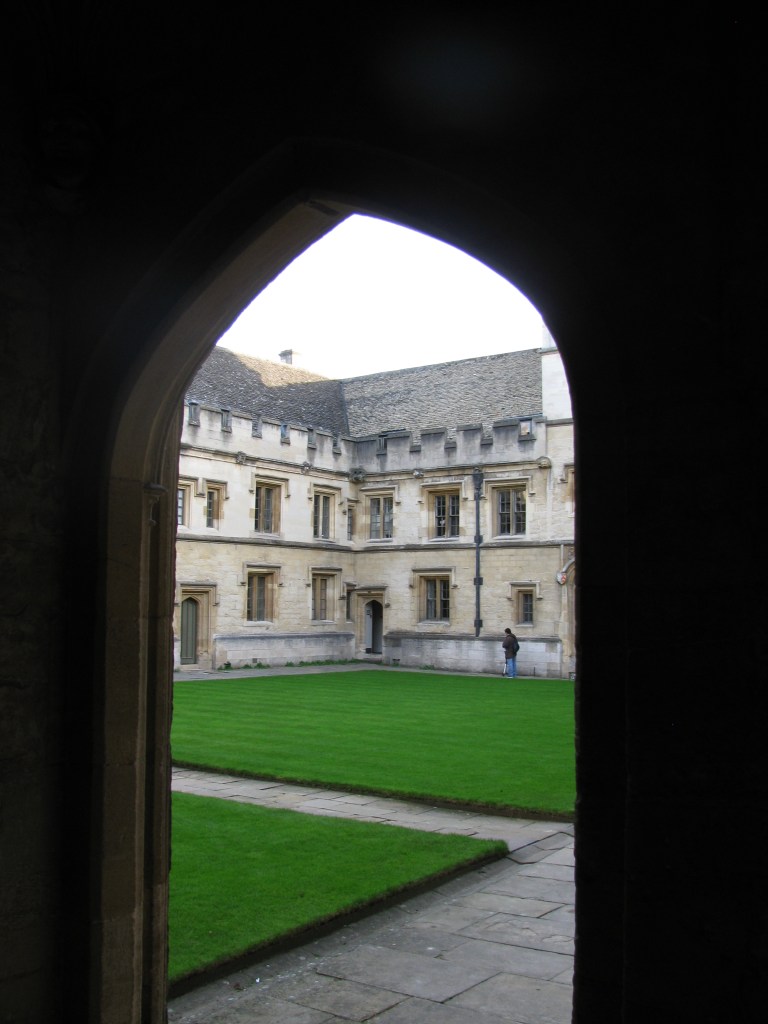
Mortimer is, like most of the colleges, built around quadrangles:
Quad at Merton CollegeNew College quadAll Souls College quad
Mortimer’s accommodation and tutors’ studies are arranged around staircases leading off the quads:
Merton College quad showing staircase entrances
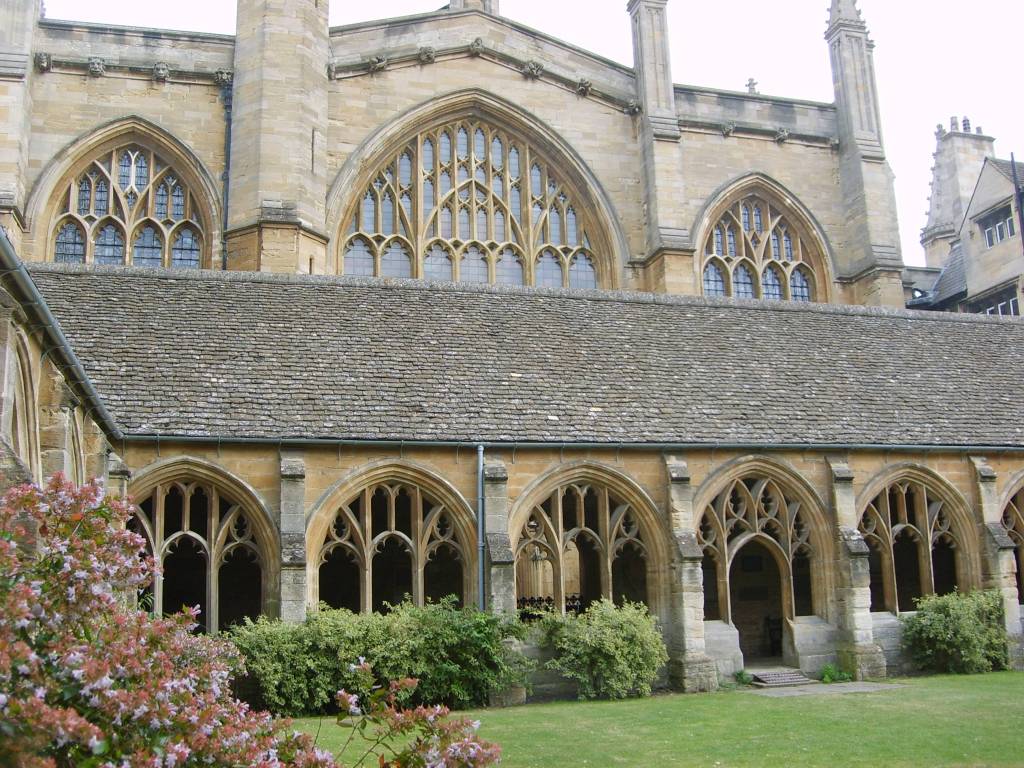
Mortimer is a most superior Oxford college because it’s one of the select few that has cloisters. The ones below are at New College and, if memory serves, were used in one of the Harry Potter films:
And finally, the dining hall. Or simply Hall, as it is known. Mortimer College’s is very much along the lines of Balliol’s below, and leaves Mark somewhat overwhelmed. High Table, where the dons dine, is actually on a different level from everyone else. At least the Balliol High Table dais doesn’t have red carpet like the one at Christ Church!
Hall, Balliol College
And that’s it for this particular whistle-stop tour! I hope it’s given some insight into the place that Mark encounters for the first time.
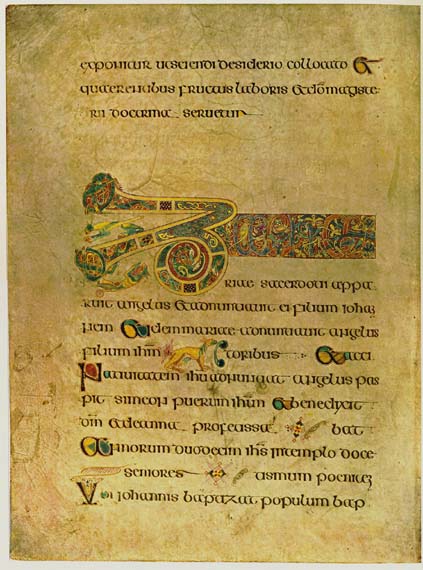
With The Red Dragon of Oxford coming out on 15th January, I’m excited to share some pictures of the beautiful Book of Kells. This exquisite medieval manuscript inspired the text known as the Rosea in my book.
The Rosea is about a century younger than the Book of Kells, dating from the late ninth century. Despite the age gap, there’s a close resemblance, with the same beautiful Latin script and vividly coloured illustrations. The pigments used for the real book, including gold and lapis lazuli, were phenomenally expensive. Perhaps this is why the colours remain so vibrant twelve hundred years later:
I love the way that not only are the initial letters are turned into beautiful pictures, but seemingly random ones throughout the text are transformed into artistic doodles.
Vaguely aware that the Book of Kells had been exhibited in Australia some years ago, I started wondering how they kept it safe during its travels. Apparently, along with being moved in great secrecy and with a security price-tag of £1 million, it was given its very own black box with a homing beacon. It was also insured for £50 million. I wonder how the underwriters arrived at that valuation — it’s not as if there are other books quite like this one.
The efforts that go into safeguarding the Book of Kells leave me with a twinge of guilt about what happens to the Rosea.
If you’d like to find out more about the Rosea along with Mark and Rufus’s story, The Red Dragon of Oxford is now available for pre-order here.
I’ve been a bit quiet of late because I’ve been busy writing. Which means a new book is coming out. The Red Dragon of Oxford is about dragon-shifters and Oxford and is the first in a new series, Wings over Albion. It releases on 15th January.
Dragons aren’t real. Or so I used to think.
Oxford isn’t exactly what I’d imagined. Sure, the colleges are romantic, and everyone is brilliant enough to trigger my impostor syndrome. I expected that.
The dragon, however, was a big surprise.
I saw him on my first day. The beautiful beast spoke to me, then disappeared. I’ve been looking for him ever since.
When I’m not on a wild dragon chase, I spend my time in the library. I’d like to think I’m only there to study, but who am I kidding?
I’m there for him.
Rufus Mortimer is the world’s hottest librarian. He’s strict, enigmatic, and sexy. He makes me feel things I’ve never felt before.
But he has a secret. One that could destroy everything.
So now, all I have to do is find a dragon, earn my doctorate, and try to not to let my new romance burn my life to the ground. Easy, right?
I wish…
The Red Dragon of Oxfordis a sweet and spicy paranormal m/m romance with a guaranteed happily ever after.
And in the meantime, Queer Romance Ink has given A Star to Sail By a lovely five-star review:
“The story is full of surprise, betrayals, cruelty, sex, secrets and ordeals…Crispin and Billy are amazing characters. If you enjoy historical books where the lead characters are gay, this one has it all.”
I do wonder why I wrote Billy and Crispin’s Caribbean adventures at the height of our summer heatwave instead of saving them for now, when I’m typing this with a hot-water bottle on my lap. Oh, well. Lesson learned for next year.
The more I read about Regency and Georgian Britain, the more fascinated and appalled I become by some of the things that were commonplace back then. Cosmetics are one of those things, with women (and, on occasion, men) painting their face with white lead and vinegar, using lipstick made from Plaster of Paris, and applying Gowland’s lotion, containing mercury, to remove pimples and freckles (and a layer of skin along with them, I presume).
18th century woman with well-defined eyebrows – hopefully her own.
It’s said that those with sunken cheeks would resort to light balls of cork to plump out their face (Fop’s Dictionary of 1690 as well as an unflattering entry in Grose’s Dictionary of the Vulgar Tongue, 1811 – “Contrivances said to be formerly worn by old maids, for filling out a pair of shrivelled cheeks”). How they ever managed to talk, let alone eat and drink, is beyond me.
Early in the Georgian period, thick eyebrows were fashionable. Women’s eyebrows were often darkened with a variety of substances including lead, burnt cork and soot. There’s a widespread belief that some ladies shaved off their own eyebrows and glued on false ones made from mouse skin. It makes a good tale, but when I read a little further, I began to question its veracity. Along with a cartoon, the main sources for this are from satirical and somewhat misogynistic poems. There are many books from the period that address facial cosmetics, the dying of beards, the dressing of hair and the construction of wigs, and it seems to me strange that instructions on how to affix and care for mouse-skin eyebrows are missing. I hope for the sake of historical mice that it is untrue!
One of the verses is from Matthew Prior in 1718:
Helen was just slipt into bed
Her eyebrows on the toilet lay
Away the kitten with them fled
As fees belonging to her prey.
So how does all this relate to an Amazon voucher? I’m undertaking a blog tour this week to celebrate the release of my Regency romance, The Earl’s Awakening, and as part of the tour, there’s a Rafflecopter for an Amazon voucher. Good luck!