Mouse-skin eyebrows and an Amazon voucher

The more I read about Regency and Georgian Britain, the more fascinated and appalled I become by some of the things that were commonplace back then. Cosmetics are one of those things, with women (and, on occasion, men) painting their face with white lead and vinegar, using lipstick made from Plaster of Paris, and applying Gowland’s lotion, containing mercury, to remove pimples and freckles (and a layer of skin along with them, I presume).

18th century woman with well-defined eyebrows – hopefully her own.

It’s said that those with sunken cheeks would resort to light balls of cork to plump out their face (Fop’s Dictionary of 1690 as well as an unflattering entry in Grose’s Dictionary of the Vulgar Tongue, 1811 – “Contrivances said to be formerly worn by old maids, for filling out a pair of shrivelled cheeks”). How they ever managed to talk, let alone eat and drink, is beyond me.

Early in the Georgian period, thick eyebrows were fashionable. Women’s eyebrows were often darkened with a variety of substances including lead, burnt cork and soot. There’s a widespread belief that some ladies shaved off their own eyebrows and glued on false ones made from mouse skin. It makes a good tale, but when I read a little further, I began to question its veracity. Along with a cartoon, the main sources for this are from satirical and somewhat misogynistic poems. There are many books from the period that address facial cosmetics, the dying of beards, the dressing of hair and the construction of wigs, and it seems to me strange that instructions on how to affix and care for mouse-skin eyebrows are missing. I hope for the sake of historical mice that it is untrue!

One of the verses is from Matthew Prior in 1718:

Watercolour of mouse.

            Helen was just slipt into bed

            Her eyebrows on the toilet lay

            Away the kitten with them fled

            As fees belonging to her prey.

So how does all this relate to an Amazon voucher? I’m undertaking a blog tour this week to celebrate the release of my Regency romance, The Earl’s Awakening, and as part of the tour, there’s a Rafflecopter for an Amazon voucher. Good luck!

The Earl’s Awakening releases today

My books are rather like buses – you wait for ages without one, and then three come along almost at once. My steamy Regency – described by one five-star reviewer as “gloriously carnal” – is out today, available at Extasy Books, Amazon, and other online retailers.

TEA cover

One glance and his past life was history

Leander Talbot’s life changed forever when his wife died. He is now reluctantly venturing back into society, knowing that, as the Earl of Ockley, he must marry again to produce an heir. But he can’t bring himself to the sticking point. Instead, he spends his time evading the matchmaking mamas of the ton.

The dark and dangerous Duke of Arden is an infamous libertine. It is said that he seduces innocents, and there are even more sinister tales whispered of his predilections. Only the wild young blades who form his retinue know the truth, but he is shunned by all save those wishing to court notoriety.

A chance meeting brings Leander into Arden’s orbit. Ignoring the warnings about Arden’s intentions, Leander is drawn into a seductive world of sexual indulgence. There, he finds the freedom he craves from his overbearing family. By the time he suspects Arden might have ulterior motives, it may be too late to save his reputation—and his heart.

Putting the pleasure in pleasure gardens

The Museum of London has summarised perfectly London’s pleasure gardens of the Georgian and Regency years – part art gallery, part fashion show and part brothel.

The gardens were designed purely for entertainment, featuring whimsical architecture, miniature waterways, and extensive shrubberies that provided opportunity for all sorts of visitors. The gardens swiftly developed a reputation for being debauched places, with one visitor wishing “there were more nightingales and fewer strumpets”.

Below: Vauxhall Gardens 1809

Vauxhall Gardens

That didn’t stop the cream of society from visiting, though! Anyone who was anyone might be seen at one, promenading in their finery, dancing, listening to concerts (Handel was practically artist in residence at Vauxhall Gardens in the 1730s and 1740s), and eating and drinking in the booths where art by Hogarth and others was displayed,

As the disgruntled visitor’s complaint suggests, the entry fee designed to exclude the riff raff had little effect on the number of prostitutes who congregated at Vauxhall, and who, by all accounts, found it a lucrative hunting ground. The main walkways through the trees were lit by lamps, but there were also the dark walks. These were unlit and so provided cover for any number of private activities. Early in the eighteenth century, magistrates enforced the lighting of the coyly named Lovers’ Walk in an attempt to deter wanton behaviour. Their insistence sounds rather Canute-like to me – one might as well try to hold back the sea as to deter lovers from seeking places to be private together.

You might think it’s a perfect place for clandestine assignations, and that’s precisely what the rakish Duke of Arden concludes in my forthcoming book The Earl’s Awakening. It’s released on 8th September and can be pre-ordered from Extasy Books, Amazon, or your favourite online bookseller.

Vauxhall Gardens in 1751, showing the extent of the shrubberies and the opportunities for assignations.

Breeches, ahoy!

Along with so many people, I have an ongoing fascination with breeches. I consider myself something of a connoisseur of Regency-era gentlemen’s nether garments, for which I blame many happy hours reading Georgette Heyer and the way Mr Beaumaris’s grandmother is surprised he can sit down in his skin-tight pantaloons.

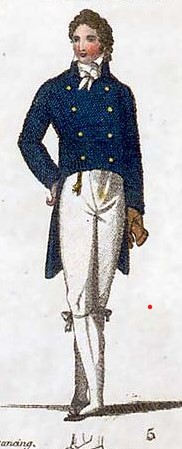
Gentleman in knee-breeches, 1811.

I am a big fan of buckskin breeches with top boots. Buckskin breeches were hard-wearing and comfortable to wear, the leather stretching and moving with the gentleman wearing them, and most fashionable, adopted as they were by so many sprigs of fashion. They could also be – and often were – skin-tight,

Ian Kelly, in his biography of Beau Brummell, describes them as highly sensuous to wear. I can’t comment on that, but they certainly look rather wonderful, framing the gentleman’s thighs with top boots and cutaway coats.

And that’s before getting into – so to speak – silk knee-breeches for evening wear (see left). Both Perry and Jack in my Carnevale series spend a lot of their time modelling these in the late eighteenth century. When they’re clothed, that is. Ahem.

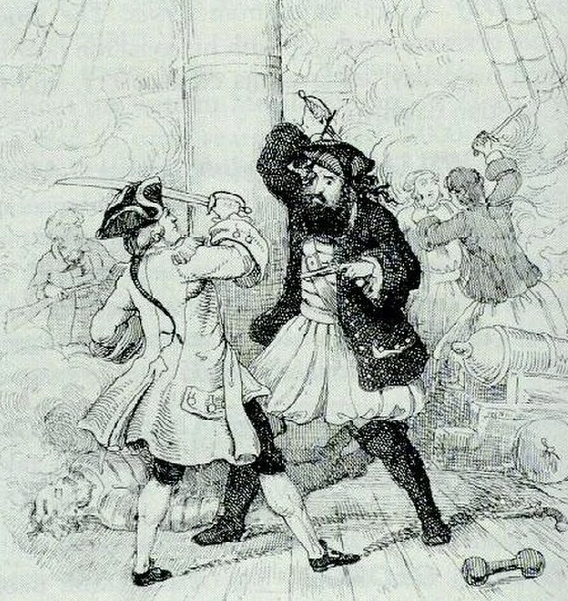
Moving swiftly on, before I began working on my pirate book, I was unfamiliar with the fashions of sailors in the early eighteenth century. I’ve ended up quite charmed by petticoat breeches, so named because when the man wearing them is standing still, they truly look as if he’s wearing a petticoat. They were fastened at the knee with ribbon, buttons or a garter. Of course, sailors had a particular need for clothes that didn’t impede them, with all that climbing of the rigging and so on, but in my book, as Billy is the ship’s gunner and rarely has to engage in all the other sailor-type chores, he spends some of his life in tighter knee breeches. It’s the best of both worlds.

Blackbeard wearing petticoat breeches.

Above: the pirate Edward Thatch (also spelled Teach), better known as Blackbeard, modelling what look to be petticoat breeches while fighting Royal Navy lieutenant Robert Maynard.

And some final Regency breeches to share with you, modelled by the rakish Duke of Arden. They may not be a completely accurate historical representation, but I think they’re rather impressive.

The Earl's Awakening cover.

The Earl’s Awakening will be published by Extasy Books on 8th September.